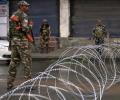
All things taken into consideration, the Taliban statement on Kashmir portends trouble ahead. The Taliban is notorious for doublespeak and when it says there is no link between the Kashmir issue and the Afghan settlement, the opposite must be taken into account as well, points out Ambassador M K Bhadrakumar.

'If there's one administration that would be likely to put the squeeze on Pakistan, it's the Trump administration.' 'This is an administration that views terrorists as a black and white issue (kill them all, no questions asked), and will have little patience for Pakistan's selective policy toward terrorism.'

The United States will provide security assistance to Pakistan to help it build counter-insurgency and counter-terrorism capabilities under a joint five-year plan developed by the two countries.

'The two NSAs, who have been mandated to address mutual concerns on terrorism, will need to devise credible and irreversible measures to see that the likes of Hafiz Saeed and Masood Azhar do not ever get a free hand to run riot again,' says Ambassador G Parthasarathy, India's former high commissioner in Pakistan.

'Is Trump going to play a mediating role? Can he play a mediating role? It's out of the question.' 'Kashmir is an Indian responsibility.'

'India was in no position to wage another war in 1965, having suffered a morale-shattering defeat in 1962. The three services were in the middle of a modernisation and expansion phase and therefore not fully trained or battle-ready.'

Arguing that Pakistan will remain a key player in counter terrorism post-2014, the United States has proposed $280 million in military assistance to the country, although it wants to cut civilian aid in an effort to acknowledge India's concerns about misuse of the funds.
'If we could break through this symbolic barrier of sanctions and a dysfunctional relationship, we could do anything.'

But the US will sell F-16 aircraft to Pakistan to fight 'terrorists.'

'One lesson to emerge out of the Modi-Putin summit is that India can be more self-confident that it possesses inherent strengths to leverage its interlocutors to influence Pakistani policies,' says Ambassador M K Bhadrakumar.
It has been over two years since Husain Haqqani was forced to resign from the coveted post of Pakistan's envoy to the United States.

New Delhi and Beijing are the only two regional capitals that have commented on US President Donald Trump's speech on August 21 outlining the way forward in Afghanistan. The Indian foreign ministry statement was effusive in praise, while the Chinese statement has been one of cautious and guarded hope. Delhi has identified itself with Trump's Afghan strategy, whereas the Chinese stance is calibrated -- observant and objective, keeping a distance, says Ambassador M K Bhadrakumar.

After weighing all the costs and benefits, the next administration is likely to reduce and restructure assistance to Pakistan but not to end it altogether, says Daniel S Markey.

'It will make good sense for military men on that side of the table to be confronted by our own.'

Rahul Gandhi's press conference showed how cocooned he may be, that he does not brainstorm with a large enough group of party colleagues and senior leaders. But it also showed how difficult it is going to be to reform an entrenched organisation like the Congress from within, says Neerja Chowdhury.
'The Senators were playing safe, not angering either the pro-India lobby or the pro-Pakistan lobby, but perhaps more importantly, the military-industrial complex -- the most powerful lobby of all -- which the majority of Senators are beholden to in terms of largesse to their campaign coffers.'
